What Are the Top 10 EV Power Station Suppliers in China?
China’s electric-vehicle charging market is moving quickly, but a supplier’s headline power rating tells only part of the story. A dependable Ev Power Station must work under real operating conditions: repeated high-power sessions, busy charging bays, summer heat, and changing vehicle demand. The details matter. Can the system share power across several connectors? Are the cables manageable, and can technicians access replacement parts without taking every charger offline?
IEA Executive Director Fatih Birol captured the broader momentum: “The global energy crisis has not slowed the momentum behind electric cars, with sales continuing to break records.” That growth raises practical questions for buyers. Which Chinese suppliers offer proven equipment, stable software, responsive service, and clear product specifications? Which can support installation and maintenance beyond a showroom demonstration?
This guide introduces ten suppliers and compares them through the capabilities that matter to fleet operators, site developers, and charging-network planners. It considers product range, charging performance, safety features, interoperability, manufacturing experience, and after-sales support. Public information can be uneven, and supplier claims do not always provide like-for-like test data. That distinction is easy to miss. No list is perfect. Treat the comparison as a starting point, then verify certifications, warranty terms, local service capacity, and references for your intended deployment. A charger that looks impressive on paper may still be the wrong fit for a crowded depot or a small roadside site.
What Is an EV Power Station and Which Suppliers Are Included?
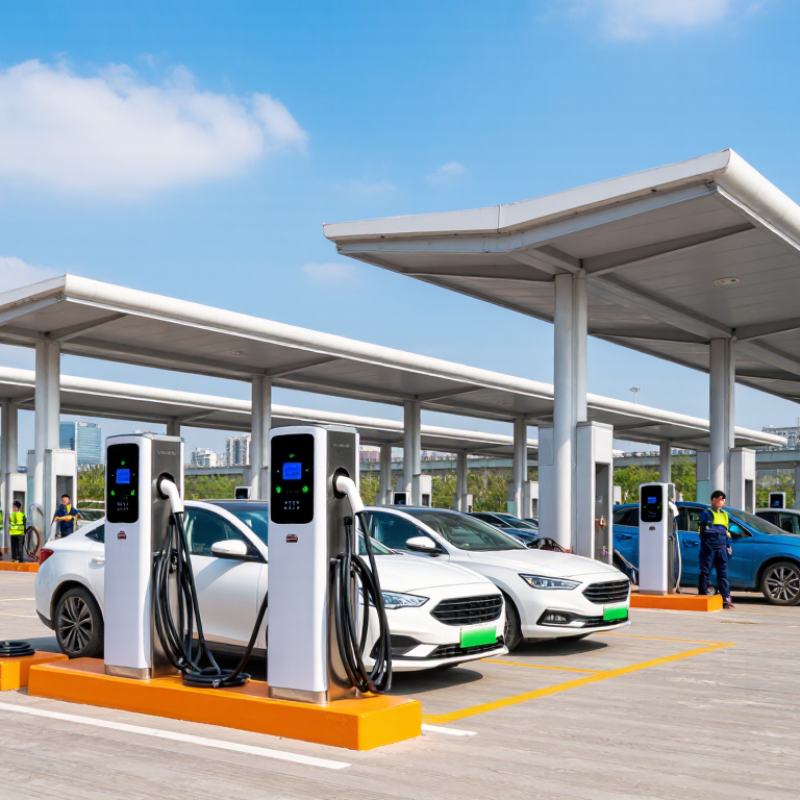
An EV power station is a site that supplies electricity to electric vehicles through charging equipment. It may include AC chargers for longer stops and high-power DC units for quicker charging. A typical site also needs grid connections, power-conversion hardware, cables, payment or access systems, and monitoring software. Some locations add battery storage to help manage peak demand. The setup varies. A roadside hub and a workplace car park have different power needs.
For a supplier comparison, the field includes more than charger manufacturers. It can cover makers of charging units, energy-storage and power-conversion systems, software providers, and installation or maintenance specialists. A useful top-ten review should check documented product specifications, real deployment experience, safety testing, service coverage, and compatibility with common vehicle connections. Look for practical details, such as output levels, cable reach, uptime reporting, and repair response times. Rankings can be imperfect: supplier capabilities change, and public project data may be limited. A clear comparison should explain its criteria rather than treat “top” as a universal fact.
What Are the Top 10 EV Power Station Suppliers in China? - What Is an EV Power Station and Which Suppliers Are Included?
An EV power station generally means electric vehicle supply equipment (EVSE)—charging equipment that delivers electricity to a vehicle. It is not necessarily an electricity-generating power plant. The table below is a brand-neutral overview of common equipment classes and supplier offerings, not a verified ranking of ten companies.
| No. | Equipment class | Representative rated output | Typical application | Common supplier offering |
| 1 | AC charging point | 7 kW | Residential and overnight charging | Wall-mounted or pedestal AC chargers |
| 2 | Three-phase AC charging point | 11 kW | Homes and workplaces with suitable three-phase supply | AC chargers with vehicle communication and protection functions |
| 3 | Higher-output AC charging point | 22 kW | Commercial parking and destination charging | Networked AC chargers, often with access-control options |
| 4 | Entry-level DC fast charger | 30 kW | Small public sites and fleet depots | Integrated DC charger cabinets with one or more charging connectors |
| 5 | DC fast charger | 60 kW | Public charging locations and commercial fleets | Standalone DC units and configurable charging systems |
| 6 | High-power DC charger | 120 kW | Urban fast-charging sites and highway service areas | DC charging equipment with power-sharing configurations |
| 7 | High-power DC charger | 180 kW | High-turnover public charging stations | Integrated or split-system chargers with monitoring and control features |
| 8 | Ultra-fast DC charging system | 240 kW | Highway hubs and large public charging sites | Modular power cabinets paired with charging dispensers |
| 9 | High-capacity DC charging system | 360 kW | Multi-vehicle charging hubs and fleet facilities | Scalable systems that can distribute power across charging outlets |
| 10 | High-capacity DC charging system | 480 kW | Large charging hubs designed for high aggregate demand | Cabinet-and-dispenser systems with site-level power management |
Note: These are representative equipment ratings, not a list of supplier market shares or a ranking. Actual charging power depends on the vehicle, charger configuration, electrical supply, and power allocation when multiple vehicles charge simultaneously.
How China’s EV Power Station Supply Market Is Organized
China’s EV power-station supply market is organized less like a simple ranking and more like a chain of linked specialties. Some suppliers build charging posts and power modules; others integrate cabinets, cooling, control software, and payment systems. A station is assembled from many layers.
At project level, system integrators match equipment to site capacity, vehicle mix, and grid access. Construction and electrical contractors handle foundations, cable runs, switchgear, and commissioning, while operators manage uptime, pricing, and maintenance. Energy-storage and load-management providers may join where grid capacity is tight or demand changes sharply. The boundaries are not clean. A supplier may manufacture hardware and offer monitoring, yet outsource installation or field service. The map shifts.
For buyers, category matters more than a headline supplier count. Check rated output, connector compatibility, protection features, remote fault records, spare-part access, and regional service response. Ask who owns each task after handover. This is where proposals often feel less clear than brochures. It depends. Standards and project needs can vary, so compare documentation against the actual site rather than assuming one setup fits all. A small depot and a highway hub are not the same job.
What Criteria Identify Leading EV Power Station Suppliers?
A credible EV power station supplier should prove more than a high charging rate. Look for clear test data on output stability, connector compatibility, thermal control, and performance under heavy use. Ask how the system handles several vehicles charging at once. A neat specification sheet helps, but real operating conditions matter more.
Safety and reliability need verifiable evidence. Review independent test reports, quality controls, warranty terms, and procedures for software updates. Ask how quickly technicians can diagnose faults and whether replacement parts are available locally. Downtime has a cost. A supplier that explains limits plainly may be more dependable than one promising perfect uptime.
Installation support is another useful measure. Leading suppliers should provide load assessments, site plans, commissioning guidance, and training for operators. Their equipment should also fit the site's electrical capacity and future expansion plans. Compare lifecycle costs, not just purchase prices. No scorecard captures every site; I would not pretend otherwise. Still, specific answers, documented results, and candid discussion of trade-offs offer a stronger basis for choosing.
Who Are 10 Major EV Power Station Suppliers in China?
China’s EV charging market includes more than charger manufacturers. A useful view of ten major supplier groups starts with makers of DC fast chargers and AC destination chargers. Both serve different driving patterns. DC units suit highway stops and busy urban sites, while AC units work well in workplaces and residential parking.
Other key suppliers include integrated charging-station builders, power-module producers, liquid-cooled high-power charger specialists, and firms pairing batteries with charging equipment. The remaining groups include charging-network operators, fleet-depot solution providers, commercial and home charger makers, and suppliers of charging cables and connectors. These roles can overlap. A single provider may design hardware, install it, and manage software. Details matter.
For buyers, supplier names alone reveal little. Check output range, connector compatibility, operating temperature, service coverage, and the clarity of warranty terms. Ask for performance records from sites with similar traffic and climate. A glossy specification sheet is not field evidence. Some public supplier lists also mix manufacturers with installers and network operators, so comparisons can be imperfect. That distinction is easy to miss.
China’s EV Charging Infrastructure Growth (2020–2024)
China’s charging network expanded rapidly, creating growing opportunities for EV charging station suppliers. The chart shows reported public and private charging infrastructure at each year-end, in millions of units. Source: China’s National Energy Administration.
How Do Their Products and Capabilities Differ?
Suppliers of EV power stations in China differ in how they balance output, storage, and site requirements. Some focus on high-power charging cabinets for busy roadside locations. Others offer battery-buffered units that can support sites with limited grid capacity. A unit’s peak rating tells only part of the story. Buyers should also compare sustained output, recharge time, connector options, and performance across hot and cold conditions.
Their capabilities vary, too. Strong engineering teams can coordinate battery management, power conversion, cooling, and control software as one system. Manufacturing depth affects consistency, while customization can help fit a station into a tight parking bay or an existing electrical layout.
Ask suppliers for test records, service response times, spare-part plans, and clear warranty terms. Numbers matter. So does support. A useful comparison checks how output changes when several vehicles charge at once, not just what a product sheet promises.
The detail can be inconvenient, and some specifications are hard to compare fairly. That deserves a closer look. A short site trial may reveal cable reach, screen readability in bright sun, and noise from cooling fans—details that spreadsheets often miss.